Showing posts with label sidewalk. Show all posts

Friday, October 22, 2021

Keep Sidewalks Clear Of Leaves, Remind Gardening Crews To Pick Up Leaves, Not Blow Them To Adjacent Yards Or Into Street


The Laurelhurst Blog has received several emails about slippery areas around the neighborhood due to leaves in public areas.  

City Code requires property owners to keep adjacent sidewalks, roads, and alleys clear of all obstructions, including raking leaves, shoveling snow and repairing damaged sidewalks

Here is the applicable Seattle City Code:

SMC 10.52.030 Duties of owners and occupants.
A. It is the duty of the owner of the property and of any occupant of the property wherein or whereon any such nuisance exists to abate the nuisance by destroying, removing or trimming vegetation, and removing or destroying any health, safety or fire hazard.
B. In addition to duties the owner or occupant may have to abate nuisances, the owner or occupant of property shall:
1. Remove vegetation in or on an abutting sidewalk;
2. Destroy, remove or trim vegetation or parts thereof on the property, and which are also overhanging any sidewalk within eight (8) feet measured vertically from any point on the sidewalk;
3. Destroy, remove or trim vegetation or any parts thereof on the property or on adjacent planting strips, which encroaches on or overhangs the traveled portion of the street or alley within fourteen (14) feet measured vertically from any point on the street or alley;
4. Remove vegetation constituting a safety hazard found on adjacent planting strips or alleys;
5. Remove vegetation constituting a fire hazard found on adjacent planting strips or alleys;
6. Remove vegetation constituting a health hazard found on adjacent planting strips or alleys.


Brian with Seattle Public Utlities (SPU) told the Laurelhurst Blog:

Trees make our city beautiful but fall leaves can be a safety hazard and cause street flooding. We would appreciate your help encouraging people to manage their leaves to keep them off the street and out of the storm drain.  

For serious flooding, please call 206-387-1800. For non-urgent plugged storm drains, please submit a service request here. Go here for more information.


Here are ways to manage fallen leaves: 

  • Rake leaves and put them into your yard waste cart. If you have more than will fit into the cart, place extras in a compostable lawn and leaf bag or a reusable container with a lid. Put them out next to your yard waste container on collection day – no plastic bags. During the month of November, SPU collects up to 10 extra bags of yard waste at no charge to the customer.  Extra yard waste must be in paper bags or in an extra container that contains only yard waste.
  • Place raked leaves on bare soil as mulch in your landscape and garden. This conserves water, controls weeds and fertilizes the soil. 
  • If you use a leaf blower, please collect the leaves to use as mulch in garden beds or bag them for collection. If you hire a landscaper to help with fall cleanup, make sure they are collecting the leaves and keeping them out of the street. 
  • You can also help reduce flooding by keeping nearby storm drains clear of leaves and debris by 1) standing on the curb, not in the street. Please do not clear drains on major streets or arterials 2) clear the drain before it starts raining 3) Never use your hands to remove debris 4) Use a long-handled dustpan, shovel or a trash can lid to pick up debris. Gloves are recommended 5) Avoid items that have the potential to be hazardous or cause injury.


Also leaf blowing from one property into another neighbor's yard or into the street is not allowed.

Neighbors wrote to the Laurelhurst Blog:

I am continually cleaning up after our neighbors lawn workers blow leaves onto our side of street, weekly.  It's not just the noise of leaf blowers that's aggravating, it's the dust that flies up into the eyes of passers-by and onto parked cars. Landscapers consistently blow the neighbor's leaves into our planting strip and in front of it, then drive off, leaving us to clean it up. Aren't they getting paid to clean up their client's yard, completely and thoroughly, including picking up their leaves and hauling them away? I noticed recently some gardeners just blowing leaves around and then blew them across the street.. Please tell your lawn crew to pick up the leaves, not blow them to your neighbors yard.
A landscaping crew working on a house on our block always blows leaves from the neighbor's yard, sidewalk and street in front of their home right into other's yards and right into the sidewalk and street in front of other homes. Is this legal? Aren't they paid to clean up the area that they service rather than just  move it down the street and then drive off leaving a mess to clean up for other neighbors? 
We regularly watch the gardening crew use their leaf blower to blow all the leaves from that house to the street and sidewalk. Blowing leaves into the street is negligent as it clogs the drains and can cause flooding, as well as possibly running the risk of getting water in someone’s basement.  Additionally, the City is not always readily available to clean the drain. Crews that are dispatched to clear the streets also can be hampered by added debris in the street. It is also disrespectful and lazy as the crew assumes the neighbors will clean up the large amount of leaves and other debris left by the gardening crew.  
We have seen pedestrians and even a landscape crew dump yard waste and other matter into our containers and those of our neighbors. Is this legal? We don't believe it is. Sometimes we watch them just blow the leaves onto someone else's property, into the street in front of another home, or just blow them down the sidewalk.


City Municipal Code SMC 15.46.030 states: 

Deposits in street or gutter
It is unlawful to wash or sweep or otherwise deposit any matter in any street or gutter.


Seattle Municipal Code Section 21.36.440 states:

Unlawful use of solid waste container on private property 
It is unlawful for anyone not authorized by the property owner or
occupant to deposit any material in any solid waste container on
private property or on a sidewalk or a planting strip abutting private
property.

Regarding permissible sound levels emitted by leaf blowers, Seattle Municipal Codes sections 25.08.410 and SMC 25.08.425, states that sound levels of up to 60-90 dBA at 50 feet from the source are permissible during regular working hours.  Sound levels that exceed 90 dBA can be subject to notices of violation, citation, and fines. Excessive noise can also be reported to the Seattle Police.
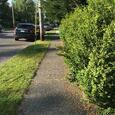
Wednesday, June 9, 2021

Keeping Sidewalks Clear Of Plantings Per City Code


Photo from Neil Wright


hedge in neighborhood


The Laurelhurst Blog has received emails from neighbors requesting that those that own overgrown hedges or other plantings partially covering sidewalks maintain them to keep sidewalks completely clear. 

Some comments received said:

Thanks for asking neighbors to be good neighbors and to take care of their sidewalks. 
Plants infringing on sidewalks is a City ordinance violation. Neighbors can upload pictures and addresses to the City's "Find It Fix it" smartphone app. The City will then contact the advise property owner to clear the debris off the sidewalk or face a fine.  I have the City Code which is very clear that horizontal or vertical intrusions of sidewalks must be abated by the property owner. There must ben an 8 feet clearance above the sidewalk and 14 feet above the street. Sidewalks must be clear all the way across. 
I have concerns about the number of overgrown shrubs, which are City code violations.   It makes it difficult to stay on the sidewalk, in some cases, and poses a danger when walking with children and pets and having to walk into the street.
Unfortunately, I was scratched across the face by a tree limb hanging over a sidewalk on an evening walk.  Neighbors can report overgrowth over a sidewalk on the Find it Fix It site as maintaining sidewalk space is the responsibility of the home owner as well as the parking strip.

It would be greatly appreciated if neighbors could trim back their plants that encroach on the sidewalks in front of their homes.  It's very hard in some areas of the neighborhood to walk side-by-side in too many places in the neighborhood. 


One neighbor received this information after reporting overgrowth from Seattle Department of Construction and Inspections (SDCI):

SDCI enforces the Seattle Municipal Code Chapter 10.52 Weeds and Vegetation Code. It applies to vegetation that originates on private property or adjacent planting strips and encroaches onto the public right of way (that is, the sidewalk, street or alley).

Property owners are required to trim or remove vegetation growing on their private property that overhangs and obstructs streets, alleys or sidewalks or creates a fire hazard. A clearance of 8 feet over sidewalks and 14 feet over traveled roadways is required. In most cases, abutting property owners must also trim vegetation that interferes with the view of an intersection at a distance of 30 feet. SDCI will inspect only those complaints of vegetation overgrowth that indicates a hazardous situation such as blocked traffic visibility or overgrowth that forces pedestrians off the sidewalk into the street. Other violations of the Weeds and Vegetation Code will be recorded and information about code requirements sent to the property owner or occupant responsible for the site. Information on regulation of vegetation overgrowth is available here. To report vegetation overgrowth from private property go here or call (206) 684-CITY (2489).


To protect the health and safety of the public, it is important to keep streets, alleys and sidewalks free of obstructions, litter, and other material.
Property owners must trim or remove overhanging trees, plants, shrubs, vegetation or debris which obstruct streets, alleys or sidewalks, or which are a fire hazard. 

Thursday, May 24, 2018

Reminder To Maintain Plantings To Keep Sidewalks Clear


Photo from Neil Wright


hedge in neighborhood


The Laurelhurst Blog has received emails from neighbors requesting that those that overgrown hedges or other plantings partially covering sidewalks to maintain them to keep sidewalks completely clear. 

Some comments received said:

Thanks for asking neighbors to be good neighbors and to take care of their sidewalks. 
Plants infringing on sidewalks is a City ordinance violation. Neighbors can upload pictures and addresses to the City's "Find It Fix it" smartphone app. The City will then contact the advise property owner to clear the debris off the sidewalk or face a fine.  
I have concerns about the number of overgrown shrubs, which are City code violations.   It makes it difficult to stay on the sidewalk, in some cases, and poses a danger when walking with children and pets and having to walk into the street.
Unfortunately, I was scratched across the face by a tree limb hanging over a sidewalk on an evening walk.  
It would be greatly appreciated if neighbors could trim back their plants that encroach on the sidewalks in front of their homes.  It's very hard in some areas of the neighborhood to walk side-by-side in too many places in the neighborhood. 


To protect the health and safety of the public, it is important to keep streets, alleys and sidewalks free of obstructions, litter, and other material.
Property owners must trim or remove overhanging trees, plants, shrubs, vegetation or debris which obstruct streets, alleys or sidewalks, or which are a fire hazard.  


Wednesday, November 2, 2016

City Advises Neighbors Not To Make Their Own Repairs To Sidewalks Or Letting Others Do So


The Laurelhurst Blog received information from neighbors about a sidewalk that appeared as if neighbors had repaired it on their own.
 
One neighbor said:

I was wondering if you had ever done a story about Seattle sidewalk maintenance, etiquette, rules etc.  
There's a hazard near the corner of NE 45th Street and 50th Avenue NE.  It looks as if a  homeowner tried to make things safer but this rubber strip is an invisible trip hazard, especially in low light. 
Most of Laurelhurst sidewalks are clear and safe but some have tripping hazards or overgrown plantings or ice in the winter.  
My understanding is that homeowners are liable for the injury these hazards can cause. Maintenance or repair is obviously better than waiting for someone to get hurt.  Sidewalk replacement can be expensive and needs permits.  


The 2' square pattern looks uniform but also provides
information for the vision impaired. 


Here is a more typical sidewalk issue


This is a helpful patch. Is this legal?


The Laurelhurst Blog contacted City of Seattle Department of Transportation who said:
 
Thank you for contacting SDOT with your sidewalk concerns. We had a Street Use Inspector go to the site and spoke with the home owner about the rubber strip. Their cable provider placed the rubber strip over a temporary cable line.  
Our inspector advised the home owner to communicate with the cable provider to remove the cable and strip and suggested an overhead connection.  
Our inspector will make a return visit to ensure the cable and rubber strip were removed as requested.  
We discourage community members placing objects over sidewalks and public facilities that may pose a safety hazard.


Here is information regarding maintaining sidewalks in Seattle:


Seattle law requires adjacent property owners to maintain and clean sidewalks. 
As in many other cities, the Seattle Municipal Code requires that adjacent property owners keep their sidewalks in good repair and safe for public travel.  This means keeping the sidewalk clear from vegetation overgrowth, snow and ice accumulation, as well as making repairs to the sidewalks when damaged. Additional information for adjacent property owners can be found here.

Prior to repairing the sidewalk, the property owner or the contractor must obtain a Street Use Permit.  This ensures the walkway meets the City's standards.  If a tree is causing the damage, an SDOT Arborist will arrange to meet on site to evaluate the tree for root pruning potential in conjunction with the Street Use Permit.   
However, if the sidewalk damage is being caused by City infrastructure such as a City-owned tree or sewer line, the City will take the responsibility for making the repairs. 

http://www.seattle.gov/transportation/images/temp_shim.jpgThe Sidewalk Repair Program ensures safe and accessible sidewalks by:
  • Investigating complaints of unsafe or inaccessible sidewalks
  • Implementing temporary measures as needed (these include painting the sidewalks to provide warning notice, placing asphalt shims, beveling sidewalk uplifts, or closing sidewalks if needed).
  • Determining repair responsibility (adjacent property owner, City, or other utility)
  • Permanently repairing sidewalks when it is determined to be the City’s responsibility
How Does SDOT Prioritize Sidewalk Repair Locations?
In order for a damaged sidewalk to be considered for repair by the SDOT sidewalk repair program it must be adjacent to City-owned property, or  adjacent to City-owned property, or City owned trees must be causing the damage.


Damage caused by other City agencies or public utilities is forwarded on to the appropriate agency for repair. If the location meets the above criteria, then repair locations for the Sidewalk Repair Program are selected based on the following criteria:
  1. Leveraging opportunities with other capital projects
  2. Within an urban village
  3. Adjacent to an arterial street
  4. High Priority Project Areas as identified in the Pedestrian Master Plan
  5. Within three blocks of a community or healthcare facility such as a school, park, library, clinic, hospital, or senior housing
  6. On a block with a transit stop
  7. Geographic and social justice distribution
  8. Constructability and cost

The criteria above are intended to ensure that the repairs will benefit a significant number of pedestrians, and the greatest number of users. The more of the criteria a specific location meets, the more likely the location is to be prioritized for repair. However, the City has a significant backlog of locations and SDOT is unable to repair many of the identified locations that meet all the criteria.


Friday, November 7, 2014

Illegal To Block Sidewalk With Car

 
Several neighbors have emailed the Laurelhurst Blog Staff to remind residents about not blocking sidewalks with their cars.

Pedestrians, adults and children, have to walk out into the street to get around a vehicle which is a safety hazard. It is not legal to park in the area where a sidewalk is.

Seattle Municipal Code 11.14.570 Sidewalk states:
“Sidewalk” means that area between the curb lines or the lateral edge lines of a roadway and the adjacent property, intended for the use of pedestrians or such portion of private property parallel and in proximity to a street or alley and dedicated to use by pedestrians.  
For the purposes of this subtitle, there is always deemed to be a sidewalk not less than three (3)feet in width, whether actually constructed or not, on each side of each street except where there is less than three (3) feet between the edge of the roadway and a physical obstruction which prohibits reasonable use by pedestrians.  
The sidewalk is located where constructed, or if not constructed, adjacent to the property line or as close thereto as can reasonably be used by pedestrians; provided, that no sidewalk shall be deemed to exist on private property unless it is actually constructed.
 

Pedestrians who encounter a car parked on a sidewalk should call Seattle Police Department's Parking Enforcement Unit at 206-386-9012.

Wednesday, July 23, 2014

Large Boulder Blocking Sidewalk For Last Few Months


We have received several emails about a large boulder that has been blocking the sidewalk in the 4100 block of 55th Avenue NE.

The boulder rolled down from the nearby property and was never put back in place, a resident told us. Someone put cones around it and it has been left like that for some time, causing a safety hazard for those who are not able to use that portion of the sidewalk and have to walk into the street.

One email said:
We don't understand why one of the large boulders from the rockery at the residence remains on the sidewalk almost fourth months after rolling there. Why hasn't the rock been removed and put back in place?
 
Another email said:
We are concerned about the boulder on the sidewalk and other boulders that could also possibly roll down from the rockery at the residence on 55th Avenue NE.  
They don't seem very secure and could injure pedestrians who rock near there.  
Also having the sidewalk blocked by the boulder causes a safety hazard as pedestrians have to walk into the street.  
When will it be removed? And why is it taking so long?
 
SDOT's website says regarding a property owner’s responsibility for streets and sidewalks:
Streets and sidewalks are for everyone's use. They add value to private property by providing access to the property and a way to get to other places in the city. 
Owners are responsible for maintaining part of the public right-of-way next to their property, including the sidewalk and planting strip. 

A Laurelhurst Community Club Board member said to use the DPD form and list code violation as the problem and  DPD will forward it onto SDOT as SDOT doesn't have their own form.  The phone number is 206-615-0808.


Monday, June 16, 2014

Neighbor Requests Sidewalks Be Kept Clear Of Shrubs

We received this email:
I live in Laurelhurst and walk my dog everyday. Sometimes I walk with a family member or friend and it's impossible to walk side by side in many parts of Laurelhurst because neighbors have allowed their plants/trees/bushes to grow onto the sidewalk.  
Please cut back plants to keep sidewalks clear for walking. Also cut trees above the sidewalk. This is a requirement of all homeowners. Instead of making us call the City and report this, please be a good neighbor and take care of your sidewalks.

Seattle City law requires adjacent property owners to maintain and clean sidewalks as stated on their website:
The Seattle Municipal Code requires that adjacent property owners keep their sidewalks in good repair and safe for public travel.  This means keeping the sidewalk clear from vegetation overgrowth, snow and ice accumulation, as well as making repairs to the sidewalks when damaged. Additional information for adjacent property owners can be found here 

To report sidewalk concerns or for questions go here.


Monday, December 10, 2012

Blocking Sidewalks With Car/Truck Can Result In A Fine

We've heard from several readers frustrated over neighbors blocking sidewalks with cars, construction vehicles, etc.

One resident near the Laurelhurst Elementary School wrote:
It would be great if neighbors who have work being done on their property have their workers pull their trucks all the way into their driveway, rather than partially or completing blocking passage on a sidewalk.
There are many children, and others who use the sidewalk to take walks or commute and it presents a hazard to those on foot as they have to step out into the street. I believe one needs a permit from the City to block a sidewalk. Thanks.
The Seattle Police Department and the Laurelhurst Community Club Board of Trustees have received numerous complaints that our vehicles are partially blocking the sidewalk. 
 
The Laurelhurst Community Club wrote in one of their recent newsletters:
It is against the law to block the sidewalk and the Police will and do ticket vehicles.  The fine is
$ 47.


Friday, November 30, 2012

Reader Asks Neighbors To Clear Leaves From Slippery Sidewalks


A reader sent us this email about slippery sidewalks covered with leaves:
It would be great if you could remind neighbors to clean the leaves and debris off their city sidewalks. The leaves have become slippery and then when frost is added it is downright dangerous, especially for us oldsters.  
Thanks, Laurelhurst walker

Here are applicable Seattle City Codes pertaining to residents keeping sidewalks in front of their home clear:


SMC 10.52.030 Duties of owners and occupants.
A. It is the duty of the owner of the property and of any occupant of the property wherein or whereon any such nuisance exists to abate the nuisance by destroying, removing or trimming vegetation, and removing or destroying any health, safety or fire hazard.
B. In addition to duties the owner or occupant may have to abate nuisances, the owner or occupant of property shall:
1. Remove vegetation in or on an abutting sidewalk;
2. Destroy, remove or trim vegetation or parts thereof on the property, and which are also overhanging any sidewalk within eight (8) feet measured vertically from any point on the sidewalk;
3. Destroy, remove or trim vegetation or any parts thereof on the property or on adjacent planting strips, which encroaches on or overhangs the traveled portion of the street or alley within fourteen (14) feet measured vertically from any point on the street or alley;
4. Remove vegetation constituting a safety hazard found on adjacent planting strips or alleys;
5. Remove vegetation constituting a fire hazard found on adjacent planting strips or alleys;
6. Remove vegetation constituting a health hazard found on adjacent planting strips or alleys.
 
SMC 15.48.010 Snow and ice removal.
It is the responsibility of the owner or occupant of private property to remove snow and ice on the sidewalks abutting his or her property in a timely manner and, if practical, prevent its becoming or remaining in an icy, ridged, uneven or humped condition or in a condition which is potentially hazardous to users of the public sidewalks.
 
SMC 15.72.010 Notice to clear or clean sidewalk.
Whenever, in the judgment of the Director of Transportation, the condition of any sidewalk, or any portion thereof, in the City is such as to render the same unfit or unsafe for purposes of public travel, or require clearing, cleaning, repair or renewal, said official is authorized, empowered and directed to serve upon the owner of the property immediately abutting upon the sidewalk, a notice advising such owner of the condition thereof and instructing him/her to clear, clean, repair or renew the same.

Thursday, August 12, 2010

Why Trees Have Been Cut Down Along Sand Point Way NE


Several readers sent us email asking if we knew why trees have been cut down just west of Katterman's on the east side of Sand Point Way between NE 50th and 47th Avenue NE.

And the reason is because sidewalks are going to be installed as part of the City's Sidewalk Development Program, in which SDOT "is committed to increasing the number of sidewalks"  in  Seattle. City. The funding is through the Bridging the Gap levy, as well as availability of local, state or federal grants.

Three pedestrian improvement projects are slated for Sand Point Way NE this year. "Each project was selected using Seattle’s recently-adopted Pedestrian Master Plan and will fill in important gaps in the existing sidewalk network," as well as "enhance pedestrian safety, comfort and access," the website says.

The section near Katterman's will be a "longer section of new sidewalk along the east side of Sand Point Way between NE 50th Street and 47th Avenue NE. SDOT’s preliminary design includes a 6’ wide concrete sidewalk with a planting strip.

Curb will be included along some sections of this new sidewalk. Parallel parking spaces will be provided along sections of the project on the existing pavement between the roadway and the new planting strip."

Bonnie, from the Hawthorne Hills Community Council wrote in an email that she received a call from a representative from SDOT who said that they are working with Seattle City Light on that portion of to take out trees for their lines as well as prepping for the installation of a sidewalk.

The other two projects are near the Fairway Estates Community just north of NOAA to improve access to and from the Magnuson spur of the Burke-Trail and construction is expected to start in late Spring.

And the third project which has already begun is on the west side of Sand Point Way NE between NE 65th and NE 70th Streets.

Also involved in securing funding for this project were the Hawthorne Hills Community Council and Laurelhurst Community Club who worked for many years to get funding for sidewalks on Sand Point Way and received funding through the Neighborhood Street Fund.