Showing posts with label union bay natural area. Show all posts

Wednesday, February 8, 2023

Two Eagles Down


Here is a recent post from the Union Bay Watch Blog published by Larry Hubbell, long-time local photographer and birder.

Eagles Down January 11, 2023

Eagles grabbing talons and cartwheeling through the air is not a common occurrence, but it does happen. This photo, from 2015, is the only time I have seen it happen near Union Bay. This pair of immature eagles ultimately let go of each other - thereby avoiding a splash-down in Montlake Cut.

My friend, Tom Cotner, pointed out that with adults cartwheeling is often part of their courtship behavior. Our three local adult pairs have been residents of Union Bay for many years. I have never seen any of them cartwheeling. I wonder if courtship is no longer required once a relationship passes a certain age.

Saturday, just before dark, I received a message from Tom. He had heard that two Bald Eagles had fallen to the ground and were still entangled near the Montlake Community Center. We assumed this was the result of them cartwheeling and then failing to disengage before hitting the ground. Tom was told that one of the two might be dead. He was wondering how and if we could help.

The only appropriate and legal way to help is to contact someone who is federally authorized and trained to handle Bald Eagles. However, I was hesitant to call for help without personally accessing the situation. Sometimes, stunned eagles can shake off a fall and simply get up and fly away. We both hurried to the site.

It was beginning to get dark, but there was still enough light to see both eagles were perfectly still. The open eye on the upper eagle did not even blink. I wondered if they were both dead. The upper eagle seemed a bit immature, given its tail and head were not quite completely covered with pure white feathers. I wondered if it initiated the cartwheel as practice for future courting. The other Bald Eagle looked mature. Although, in this case, there was some discoloration which appeared to be blood on the tail.

Tom eventually moved slightly closer to the eagles while trying to determine if they were alive. I imagine he was looking for signs of breathing. Both eagles shifted their heads to keep an eye on him. I immediately called the Seattle Animal Shelter, explained the situation, and requested help. An officer was dispatched to recover the eagles.

A few other concerned souls gathered nearby to quietly wait for the rescue. Behind us in the middle of the Montlake track, a group of people and their off-leash dogs were running around unaware of the eagles on the ground. While we waited, I explained to them that an Animal Control Officer was on the way to help with the eagles. They leashed their dogs, which was much safer for the eagles, before leaving.

Even without dogs around, if the eagles were stuck on the ground at night they would not be safe. We have coyotes, otters and raccoons in the city and I imagine any one of them might be interested in a bald eagle that is unable to fly.

Suddenly, both eagles seemed to come to life and started calling and struggling with each other. The one on top began flapping its wings and pulling to get free. They finally separated and for a moment they stood side by side. Then the younger bird spread its wings and flew away to the north. Disappearing into the dusk. 

The older bird walked slowly into the surrounding foliage, something about its left wing did not look right. As darkness fell the reflection of its white head was the only clue to its location. Eventually, the Animal Control Officers arrived and captured the injured eagle. As they left the officers confirmed it was bleeding from the left wing.

Eventually, I heard that on Sunday the injured eagle was transferred to PAWs, the Progressive Animal Welfare Society in Lynnwood. The fact that the eagle lived through the night is encouraging. We will hopefully learn more about its prognosis in a few days after it is examined by a qualified specialist.
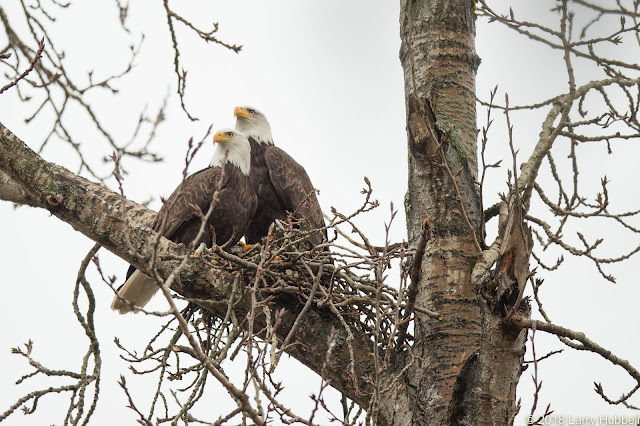
For the last five years, the area around the Montlake Community Center, just south of Portage Bay, has been part of the territory that belongs to Monty and Marsha, the Bald Eagles who nest near the southeast corner of Montlake Cut. This January 2018 photo shows Monty and Marsha at their first (partially constructed) nest. 

The scenario that seemed most likely was that one of these two local adults had been defending their territory when the encounter with the younger eagle occurred. While I wondered if the injured eagle was Monty or Marsha several other questions came to mind. How long will it take to recover? Would a healthy mate, who suddenly found itself flying solo, just before nesting season, decide to take a new mate in the meantime? If the injured eagle recovered and was then released, Would it return to the territory and begin fighting with its replacement? 

These were interesting questions, but I actually had no proof that the older eagle was Monty or Marsha. I decided to try to determine if both of them were still present in their usual locations.

On Sunday, I could not find either of the Montlake Cut eagles at any of their normal roosting spots. 

On Monday, I found what appeared to be one of the two in their favorite cottonwood tree just north of the Waterfront Activity Center. At the time I wasn't sure whether it was Monty or Marsha, but after comparing it to other photos I believe this is a photo of Marsha.

On Tuesday, my luck improved. I saw one adult Bald Eagle chasing after a second one that had just caught food. Later, I would learn that someone closer to the situation saw the eagle eating a bird with black feathers. I suspect it was one of the wintering American Coots.

After a bit, the eagles moved again, and I lost sight of them. I could still hear them calling. I headed towards the Waterfront Activity Center. I was planning to check their favorite cottonwood tree when I ran into my friend Sarah. She had also been watching the eagles but from a greater distance and a different angle. She had seen them head back toward the nest tree.

When we circled back we noticed Marsha in the nest and Monty sitting in one of his usual protective spots just above the nest. At the same time, a third Bald Eagle was sitting a few trees to the east of the nest. Apparently, all of the noise was Monty and Marsha telling the intruder to move along.

I hurried back across the bridge and around to the south side of the nest in hopes of catching some photos with a bit better lighting. Monty had left but after a few minutes, he returned. I suspect he escorted the intruder away. In any case, if you look closely you can see that both Monty and Marsha are calling out greetings to each other.

Their faces do appear to be changing as they mature. Monty is getting more of a heavy eyebrow similar to Marsha's. However, Marsha still has a tinge of discoloration on her face immediately behind her eye. In the same area, Monty seems to be developing a small furrow running away from the "back corner" of his eye. Granted, these details can be enhanced or invisible depending on the lighting.

I am happy to know these two are still together and likely to produce young again this year. However, I am still concerned for the unknown eagle that was injured and picked up near the Montlake Community Center. I will let you know when I hear more about its prognosis.

Since that eagle was not Monty or Marsha it makes me rethink what caused the entanglement that led to its injury. I wonder if it was the one who attempted a courtship ritual. Perhaps its efforts were not well received. The wonderful thing about the mysteries of nature is there are always more questions to ask and we will never know all the answers


Wednesday, February 1, 2023

Winter Bird Activity At Union Bay Natural Area

Here is a recent post from the Union Bay Watch Blog published by Larry Hubbell, long-time local photographer and birder.


The Wonders of Winter


The red waxy tips, on their inner wing feathers, inspired the last name of the Cedar Waxwings.

A female American Robin is a surprisingly beautiful bird. Her head and back are similar in color to a Waxwing, the white and dark streaks on her throat and the broken white eye-rings create wonderful contrasting highlights. Best of all her breast is a subtle shade of russet-orange that may be the most beautiful hue on a color wheel

The glowing display of the last lingering leaves is another wonderful aspect of winter beauty.

By the way, in my previous post, there is a new update regarding Varied Thrush. My friend Etta kindly reminded me that Varied Thrush do not breed in urban areas. This is also documented in BirdWeb our local, free, online birding application from Seattle Audubon.

Last week, this tiny Hermit Thrush attracted my attention, as it searched for food on this moss-covered support for the Wilcox walking bridge, in the Arboretum. 

When it flew, it landed nearby in this leafless tree. The Hermit Thrush was clearly focusing its attention on the little pink spheres.

Its feeding strategy, i.e. fluttering up, and seizing the food while hovering in mid-air, seemed somewhat extravagant. I wondered, What was attracting this exceptional attention? 

When I looked more closely, my confusion increased. I wondered, What is this? Is it a fruit,  flower, or seed? Are the outer pink parts edible? How much of this do the birds eat? 

After repeated trips, I documented one of the larger and calmer Varied Thrush as it sat and pulled out the inner reddish-orange part. Plus, as I looked closer, I realized that the empty pink "husks" were being left hanging on the tree.

Online, I found websites like this one, that solved the mystery. The pink unit as a whole is the fruit of the Spindle tree. The pink parts open up to reveal its orange seeds. On a cautionary note, this tree and its fruit are poisonous to humans, but it does not seem to bother our local Thrush.

The other mystery about this tree is how it got its name. It is called a Spindle tree because historically its durable wood was carved into spindles for spinning wool into yarn. 

Mallards are another common bird whose beauty can be easily overlooked. In early Winter, the males are adorned in a fresh set of feathers. Its beautiful new breeding plumage will hopefully attract a mate. The blue speculum, at some angles, looks purple, and it is often hidden by the bird's outer wing feathers.

We also tend to overlook female Hooded Mergansers, partly, because of the way their subtle coloring blends with the world around them.

But also, because the more extravagant males, with their contrasting colors and flashy mating behaviors, easily attract our attention.

The male Wood Duck has a beauty we see year-round, however with such a variety of colors, we tend to overlook the blue highlights on its back. I believe these are from the secondary feathers in its folded wings.

Another beautiful duck, that we usually see only during the colder months, is the Northern Pintail.

Year-round we can find Red-winged Blackbirds. Early in their lives, the males wear basic brown like the females. However, there is a window of time in their first year when the tips of their mature black feathers still retain beautiful youthful highlights of beige and brown. 

This time of year, male Northern Shovelers tend to have dark green heads while still having a few dark crescents from their non-breeding plumage on their chests. Their rich chestnut sides do an excellent job of offsetting the bright green of their speculums.

Monty and Marsha, our local Montlake Cut Bald Eagles, have bright yellow bills that blend perfectly with the Fall leaves in their favorite cottonwood tree.

Just to the north, mated pairs of the elegant Trumpeter Swans, calmly dip and feed on the aquatic vegetation below Union Bay. We are lucky to live near a bay that is shallow enough to have vegetation and yet deep enough, and south enough, to not freeze in Winter.

However, for me, one of the most heart-warming sights this week was repeatedly seeing this Wilson's Snipe and watching it bobbing its body up and down, while totally confident in its awesome camouflage.

Have a great day on Union Bay...where nature lives in the city and Black Birders are welcome!

Thursday, November 17, 2022

Tonight SUBA Meeting

The Laurelhurst Community Club (LCC) published this information in a recent newsletter: 

SUBA Annual Meeting November 17tt (Zoom )

Save Union Bay Association (SUBA);s Annual Meeting will provide an update on the progress made in the past year managing invasive aquatic plants in Union Bay. A representative from Aquatechnex will describe the treatments used, the outcomes, and the plans for 2023. There will also be reports on other SUBA business.  For questions, please email Susan Holliday, president, SUBA Board of Directors, at saveunionbayassn@ gmail.com or  go here. 

Several yeras ago LCC commended (SUBA) for their 47 years stewardship of the waters in Union Bay saying:    

With its active programs, SUBA has effectively restored the quality of water in the bay over these past six years through various applications of environmentally safe, in-water and targeted herbicide treatments.  
Since the new treatment plans were implemented, Union Bay waters have been clear, safe, and milfoil free, even as warmer climates have created toxic conditions elsewhere in the area. There were no reported toxic blooms in Union Bay in 2017, and recreational water users – swimmers, kayakers and boaters have seen a vast improvement in their ability to navigate through clearer water throughout the summer. Fish habitat continues to be enhanced, and their ability to thrive is central to the health of the entire ecosystem in Puget Sound.  
SUBA’s on-going methods to reduce the non-native water lilies is also critical as it provides more natural light and open waters that native fish need for navigation. LCC supports the work of SUBA in its next new multi-year grant cycle for these treatment programs from the Washington State Department of Ecology, the State Department of Natural Resources, and its partnering with the University of Washington Athletics and student activities programs for the in-water maintenance.  
LCC also commends the more than $20,000 in donations by SUBA’s members, primarily Laurelhurst shoreline homeowners, that are used to co-pay for these treatments, benefiting all public users of Union Bay.  
LCC also supports SUBA’s work in protecting Union Bay from other harmful impacts, such as those from the new SR520 bridge replacement. SUBA’s efforts to prevent harmful open barging of toxic waste debris, halt the non-permitted dredging and the attempt to increase night time noise variance have worked to protect the most vulnerable wildlife species, and the humans whose habitat is Union Bay.  
SUBA’s resource of the Aqua Technex in-water maps that identify locations of the invasive weeds for both current, and future records of Union Bay is a public asset. They are especially important for documenting potential adverse impacts from the construction of the new SR520 bridge.  
LCC supports the request from SUBA to WSDOT that additional mitigation may be needed for the removal of any new invasive in-water plants brought in by the SR520 construction processes of the West Approach Bridge North (WABN), and its remaining phases, and will partner on those efforts.  
Many thanks to SUBA president Susan Holliday, board members Steve Sultzbacher, John Impert, John Jacobs, and Colleen McAleer, and members for all you do for the restoration and continued vitality of Union Bay, and its efforts to protect its delicate ecosystem. SUBA is a 501-C-3 nonprofit organization.  
Please support matching funds for this important work. Send tax-deductible donations to: SUBA Treasurer Steve Sulzbacher, 4115 Surber Drive NE, Seattle, WA 98105


The Union Bay Natural Area (UBNA) is an undeveloped, 74-acre nature reserve and outdoor research laboratory on the north end of Lake Washington’s Union Bay, which provides publicly accessible wildlife habitat (more than 200 bird species have been sighted).

For many years, the land served as Seattle’s largest garbage dump, the Montlake Fill. After the landfill was closed in 1966, work began to restore the site to a more natural environment. The land, just east of the University of Washington (UW) campus, is now owned by the University and managed by the College of the Environment.  

Go here for more information.


Tuesday, September 20, 2022

All About Flycatchers in Nature

 Here is a recent post from the Union Bay Watch Blog published by Larry Hubbell, long-time local photographer and birder.


Active Waiting


Typically, this species is often seen on a perch. One might assume they are the "couch potatoes" of the avian world and therefore "sitting ducks" for small falcons and accipiters. 

The truth is they are surprisingly active. Even when stationary, their heads are constantly twisting and turning. Imagine being very hungry and standing in a three-dimensional computer room where the walls, floor, and ceiling are screens that intermittently flash snippets of pertinent information about how to secure your next meal.

Their abrupt staccato-like movements bring to mind the robot, C3PO, in the Star Wars movies. 

It is not surprising that creatures who catch flies are called Flycatchers. However, you may be surprised that they can catch enough to replenish their energy expenditures. How can they possibly move so quickly, fly frequently, and eat so little? Insects must be extremely nourishing. I suspect the Flycatcher's mid-air, last-moment adjustments may also help to make their efforts more economical - from a nutritional perspective.

It would be interesting to know how far flying insects can see. Presumably, their fatal flaw is to venture into the flycatcher's strike radius before they notice the bird. Do insects that avoid flycatchers have better eyesight? Are they faster than average? or Is it just a matter of luck?

Since Dragonflies also catch flying insects I wondered if they might be best equipped to escape the Flycatchers? In Dennis Paulson's book, "Dragonflies and Damselflies of the West", he says, "Dragonflies have the finest vision in the insect world." Later, "Dragonflies have their good vision and swift and agile flight to protect them from predators." However, he does list large Flycatchers as an important Dragonfly predator.

Dennis also mentions three different foraging methods used by Dragonflies. They are hawking, sallying, and gleaning. As you read this post you might consider which one of these methods best describes the behavior of the two Flycatcher species we consider? 

The Flycatcher's quick-twitch, insect-inspection is not just a surprisingly active form of hunting, it is also an effective method to monitor for airborne predators. 

We are blessed with multiple species of flycatchers and many have surprisingly similar characteristics. Luckily, this species, the Olive-sided Flycatcher, is an easily identified exception. Their distinctly white bellies contrast quite nicely with their olive-green sides. Their wonderfully descriptive name includes both an easily identifiable attribute and an easily observed behavior. 

Plus, their song is distinctive. "Quick, three beers!" is the mnemonic to help file it in your memory. Click Here and play the very first recording to hear it.

At some angles, the head and the bill look like they belong on a much larger bird.

When they snag an insect out of the air. If it is relatively large, they will often return to their starting point to finish the snack.

This Flycatcher killed and possibly tenderized this bee before eating it. I did not notice the stinger being removed. They are super quick and it could have happened when I blinked. However, if it did swallow the bee whole, I wonder why the poison does not cause problems?

A few days earlier, I saw one of our other species of flycatchers. It was sitting a bit lower but otherwise, its behavior was similar.

It also caught what looked like a bee and appeared to eat it without removing the stinger.

One method for distinguishing this Flycatcher from the Olive-sided species is its lack of a clean white belly.

In fact, there is no clear distinction between the belly and the sides. It's almost like it is wearing a vest that is buttoned up tight, while the more "casual" Olive-sided has an unbuttoned vest.

The Western Wood-Pewee also has a naming advantage. It says its own name, at least the final portion. Click Here and play the very first recording to hear it.

Returning to our Olive-sided Flycatcher it was bumped off of its perch by the approach of a male Northern Flicker. The Flycatcher did not seem particularly scared. It flew off to catch an insect and quickly returned to a nearby location.

The Flycatcher appeared confident it could outmaneuver the Woodpecker. 

Although, perhaps the calls of the Flicker got on its nerves.

The Flycatcher finally left. However, it was not long before a Bald Eagle passed overhead and the Northern Flicker also abandoned the conspicuous post. Every creature in the web of life has weaknesses and strengths. The key to survival may be having a clear understanding of both.

Both species of Flycatchers that we reviewed today were hunting by perching and flying out to grab airborne insects. The two other hunting styles that they did not use were hawking and gleaning.

A Red-tailed Hawk circling on thermals overhead, and watching for a rodent to reveal itself, before diving, would be appropriately described as hawking. 

A Golden-crown Kinglet closely inspecting vegetation for insects could be described as gleaning.

Tuesday, June 28, 2022

All About Barred Owls


Here is a recent post from the Union Bay Watch Blog published by Larry Hubbell, long-time local photographer and birder.


Owlet Tails


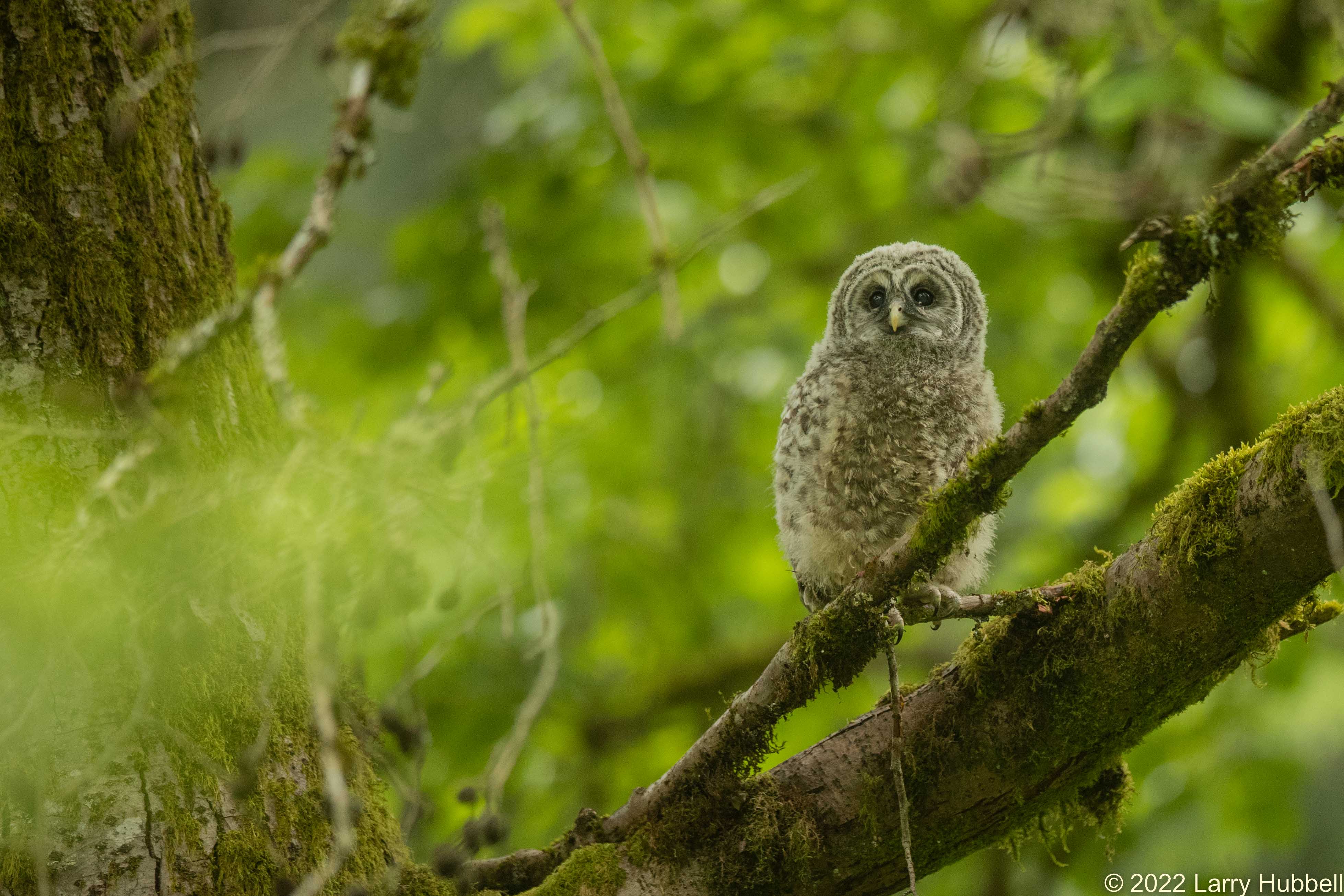
Very young Barred Owls are incredibly cute and very vulnerable. When they first leave the nest they are typically unable to fly. While learning, they often fall to the ground where they are easy targets for coyotes, raccoons, and even off-leash pets. 

Their only escape is to waddle to the base of a tree and claw their way up - one vertical step at a time. Their sharp talons help them to essentially walk up the tree trunk. This is a slow, intense process. They often stop to rest. Occasionally, they resort to using their bills to help facilitate their ascent.

I suspect this young owlet was using its wings for balance not lift. (This was my first time  seeing a tree-hugging Barred Owl.)

Ultimately, the young owl crawled up to a sizable horizontal branch. Large, level branches hidden below a thick upper canopy are one of the safest places for a young owl to hang out. They also make nice tables. In the Arboretum, the mid-level branches on Big Leaf Maples trees are often used by Barred Owls, Cooper's Hawks, and Common Ravens as dining platforms. 

The short, white-trimmed feathers, towards the center of the bird, are the owlet's tail. I am guessing the tail is maybe an inch or two long. I do not know the exact pace of rectrices growth. However, later in this post, we will see photos that imply rapid lengthening of the tail feathers once the young leave the nest.

The parents actively watch out for their young. 

In this case, the adults paid particularly close attention to a Cooper's Hawk that was calling loudly from the nearby trees.

Finally, one of the adult owls grew impatient and chased the noisy young hawk away. 

This particular young Cooper's Hawk was banded near its natal nest in Miller Park last July. Thank you to Martin, Ed, and Patti who lead the Urban Raptor Conservancy. They have been banding raptors in the city for years while developing and sharing an incredible wealth of knowledge. To learn more visit their website: Urban Raptor Conservancy.

The young owl turned and walked toward the parent.

Often both parents were in the tree but they do need to leave to find food.

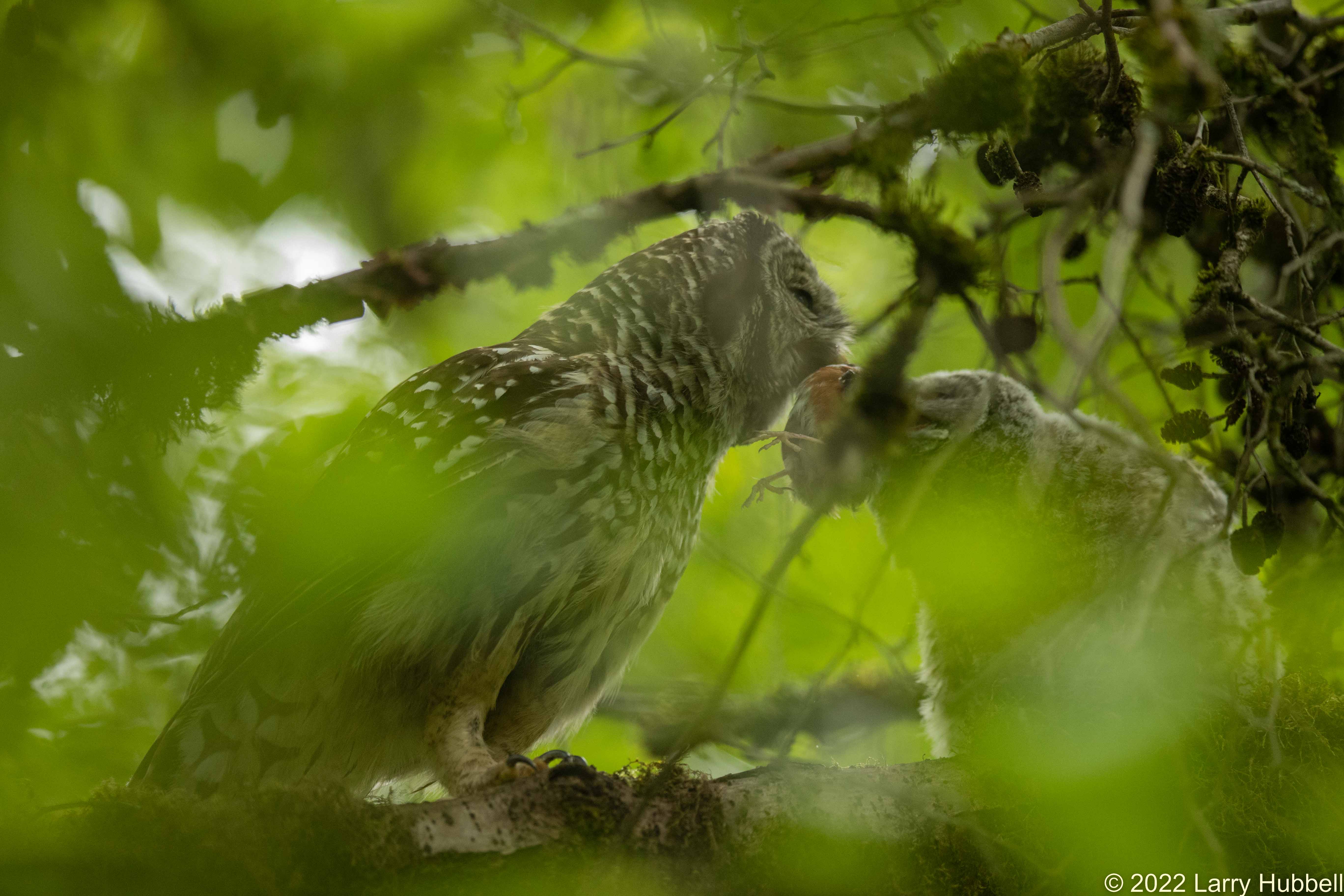
Can you tell what is on the menu? (The answer will be mentioned below.)

Owlets need a nearly constant supply of food. They don't seem to be particular about the species.

After a few exploratory bites, the young owl attempted to just swallow the body of the bird. 

Don't try this at home. We are simply not equipped for this approach to food consumption. It does make eating much faster and safer for predators. They rapidly internalize their food, leaving digestion for later and freeing them to escape harassment. 

Repeatedly, the owlet threw its head back. Slowly, one millimeter at a time, the Spotted Towhee's body began its final descent. 

Bones, meat, feathers, and feet all go down together. The indigestible parts will be regurgitated later.

***********

Thank You to everyone who has provided tips that helped me find the owlets. The list includes Roy, Ron, Tom, Bethany, Mindy, and Dan. (If I have omitted your name please excuse my memory lapse.) All your help is truly appreciated!

***********


A week later I finally found two more young owls that belonged to the pair of Barred Owls in the next territory to the north. 

Notice that this young owl's tail is considerably longer than the owlet in the previous photos even though it is still molting out of its youthful fluffy white feathers. 

I am guessing it has been out of the nest for at least three or four weeks. It is already flying, but learning to hunt will take sometime. 

When its parent caught breakfast the adult ate most of the meal before picking up the leftovers and looking for the juvenile owl.

The young owl accepted the food readily. The meager offering did not appear to be enough to satiate its hunger. The adult must walk a fine line between helping the young one to survive and not reducing its motivation to hunt. By winter, the young will be on their own and their survival will be determined primarily by their hunting skills.